Sewing standards
Every seam on every garment is made to a written standard — stitch density, seam allowance, reinforcement, and how each defect is prevented. This page is that standard, published.
Source: Internal standard: Garment Sewing Standards for Mid-to-High-End Production
Machines we run
Matching the machine to the seam is half the quality battle. These are the six categories on our floor.
| Operation | Standard | Requirements |
|---|---|---|
| Lockstitch machine | Forms a secure lockstitch — the workhorse for panel joining, side seams and shoulder seams. | — |
| Overlock machine | Wraps raw edges with multiple threads to stop fraying. Essential for both woven and knit edges. | — |
| Twin-needle machine | Two parallel needles give a double topstitch that reinforces and decorates at once — shirt plackets, waistbands, denim. | — |
| Flatlock machine | High-stretch covering stitch for knits — T-shirt hems, cuffs and necklines that need to move. | — |
| Zigzag machine | A swinging needle produces a zigzag stitch with good extensibility — stretch fabrics, button sewing, buttonholes. | — |
| Special-purpose machines | Waistband machines, felling machines, buttonhole machines — purpose-built for one operation, and the reason high-end garments look different. | — |
General sewing standards
The baseline every operator works to, regardless of style or fabric.
| Operation | Standard | Requirements |
|---|---|---|
| Stitch density | 8 stitches per inch before washing as standard; 9–10 stitches per inch for high-end product. |
|
| Stitch quality requirements | Straight, even, defect-free, correctly tensioned, and back-tacked at every stress point. |
|
| Thread and trim matching | Match thread fibre and count to the fabric: 606 heavy thread for denim, 603 fine thread for light cloth, high-stretch thread for stretch fabric. |
|
Denim critical operations
Where denim garments actually fail — and the standard we hold each operation to.
| Operation | Standard | Requirements |
|---|---|---|
| Waistband closing | Body and waistband joined in one continuous pass, with the seam allowance fully wrapped and hidden inside — less bulk, no raw edge on the face. | — |
| Belt loops | Uniform height and width, even spacing around the waistband; lower end buried in the waistband seam, both ends bartacked. |
|
| Fly & zipper | Zipper tape sewn to the fly facing so the zip runs smoothly and the topstitch is symmetric; double-row tail stitching with hidden bartack, single row bound to prevent wash abrasion. | — |
| Overlocking (edge binding) | Raw edges fully wrapped to stop denim unravelling; 5-thread overlock both joins and binds. No yarn loss or frayed edges after washing. | — |
| Felled seam | Seam allowance completely enclosed inside the panel — no raw edge visible on the face. Double-needle chainstitch: high strength, survives repeated washing. | — |
| Back pockets | Left, right and bottom edges overlocked before assembly; bartack with reinforcement at pocket corners; a plastic guard strip is sewn at the face corner for washed styles. | — |
| Leg hem | Turned and stitched to lock the raw edge; flat and straight, both legs identical in width — no twisted or puckered hems. | — |
| Pocket bags | Pocket facing is pre-shrunk on all four sides to the fabric's shrinkage rate, pressed flat, then overlocked before the bag is set. Flat before washing, pressed flat after. | — |
| Interlining at stress points | Fusible interlining applied at button positions, buttonholes and the fly to carry the pull load and reduce wash creasing. | — |
Plackets & fronts
The front is the first thing a customer looks at — it is also where quality is judged fastest.
| Operation | Standard | Requirements |
|---|---|---|
| Shirt placket | Single-band placket: 3.5 cm facing, interlining fused flat without bubbles, topstitch 0.5 cm from the edge, straight and even with no skipped stitches. |
|
| Zipper placket | Tape aligned exactly with the placket edge, stitching straight; teeth run smoothly with no snagging, no puckering or twisting. | — |
| Denim jacket front | Left facing and right overlap finished cleanly; two rows of topstitch for strength and looks, with even stitch density. | — |
Quilting (special process)
Three layers — shell, interlining and fill — held in place. It fixes the fill and gives the garment its surface character.
| Operation | Standard | Requirements |
|---|---|---|
| Stitch density | Minimum 12 stitches per 3 cm — strong enough to prevent seam opening and fill escape. | — |
| Pattern regularity | Square, evenly sized grids per specification, so fill stays evenly distributed with no clumping or shifting. | — |
| Stitch appearance | Smooth and straight with no skipped, broken or floating thread; face and back identical. | — |
| Down-proof finish | Dedicated down-proof needles with increased stitch density to close the needle holes — no fill escaping. | — |
Defects: cause & prevention
Four defects account for most rejected garments. Here is why each happens and how we stop it.
| Operation | Standard | Requirements |
|---|---|---|
| Skipped stitches | Cause: wrong or bent needle, unbalanced tension, or excessive clearance between hook and needle. |
|
| Thread breakage | Cause: poor thread quality, over-tension, needle overheating, or a wrong threading path that abrades the thread. |
|
| Seam puckering | Cause: fabric and thread tension mismatch, incorrect presser-foot pressure, or uneven feed on light, soft cloth. |
|
| Uneven seam allowance | Cause: untrained handling, poor cut-panel accuracy, or worn feed dogs causing uneven feeding. |
|
Wash finishes
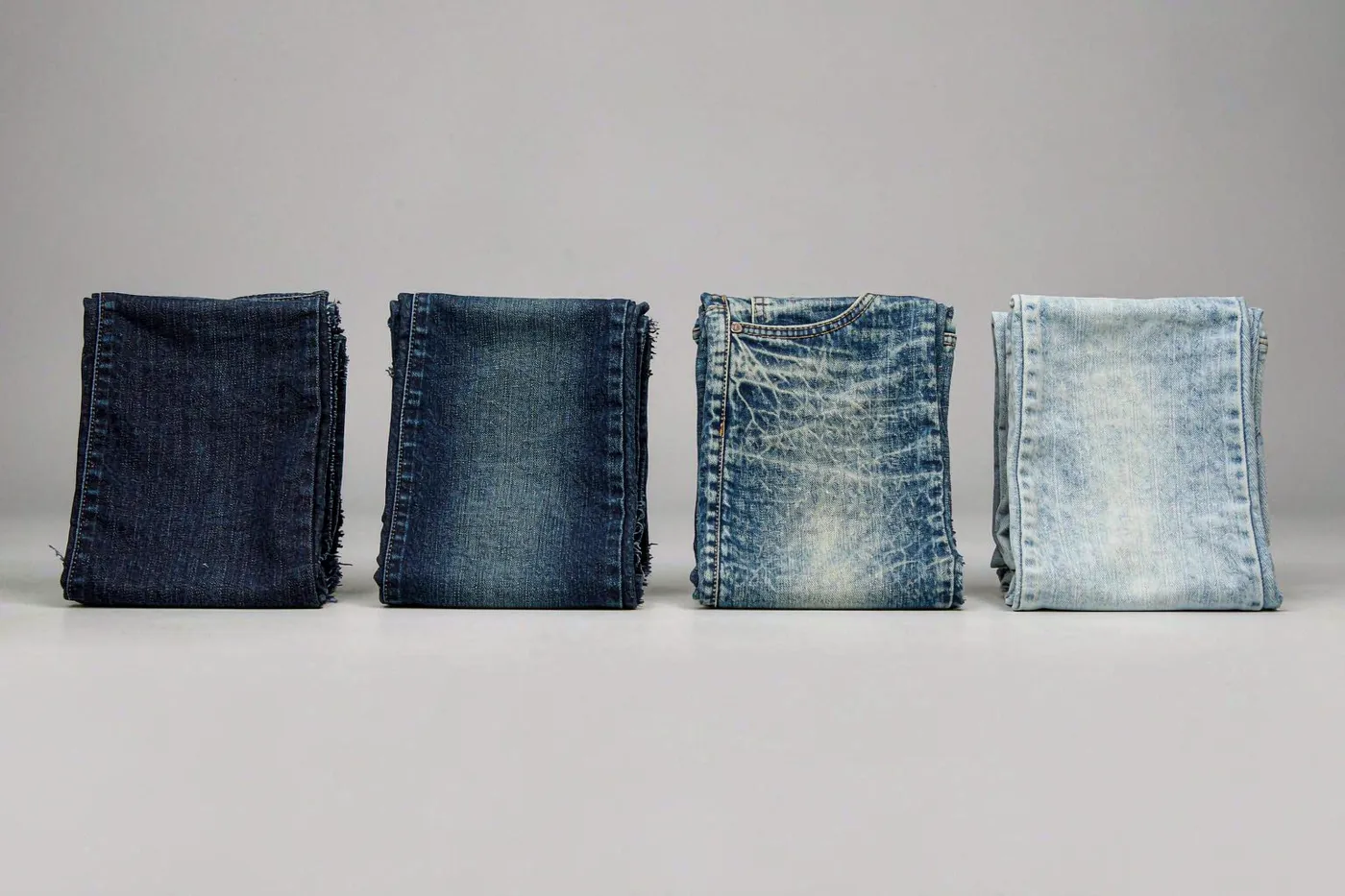
Four base washes. The deeper the wash, the more the garment keeps changing on the wearer.
| Process | Appearance | How it fades | Cost / cycle |
|---|---|---|---|
| Raw / unwashed | Deep indigo, sized and stiff. No whiskers, no obvious abrasion. | Fades with wear into a pattern unique to the wearer | Low cost / short cycle |
| Rinse / one wash | Mid blue, softened hand. Slight colour loss, shrinkage stabilised. | Fades slowly and evenly | Low cost / short cycle |
| Stone wash | Light blue with whiskers and honeycombs at elbow and knee. | Set at the wash — changes little with wear | Medium cost / medium cycle |
| Bleach / acid wash | Very pale blue-white with a snowflake pattern, heavy distressed character. | Fibre strength drops — wash temperature must be controlled | High cost / long cycle |
Secondary processing
Everything that happens after the wash — hand work, laser, coating and repair. Combine freely.
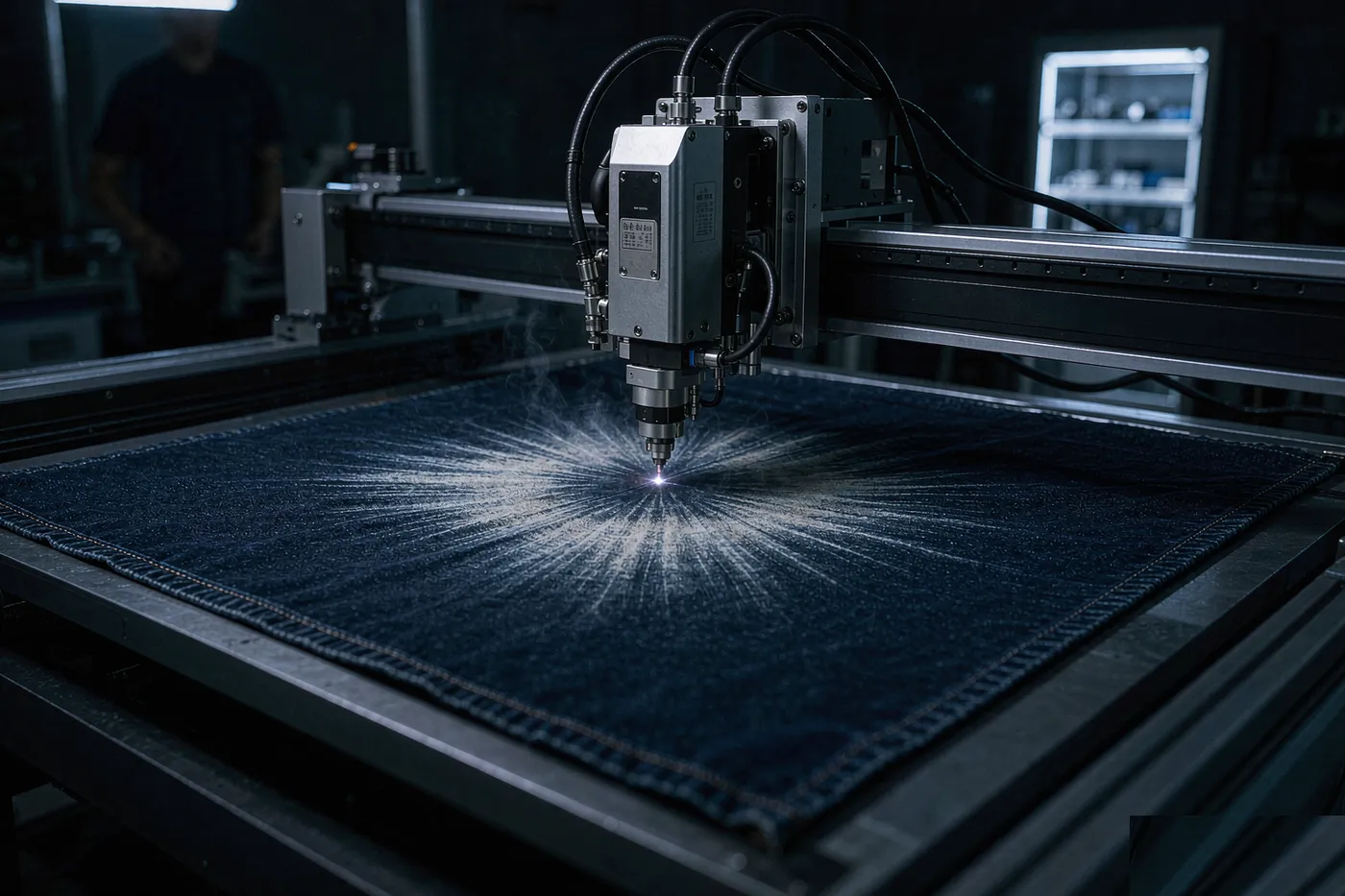
Digital patterns etched directly onto the cloth — repeatable and batch-stable, saves water and labour. Lacks the randomness of hand work.
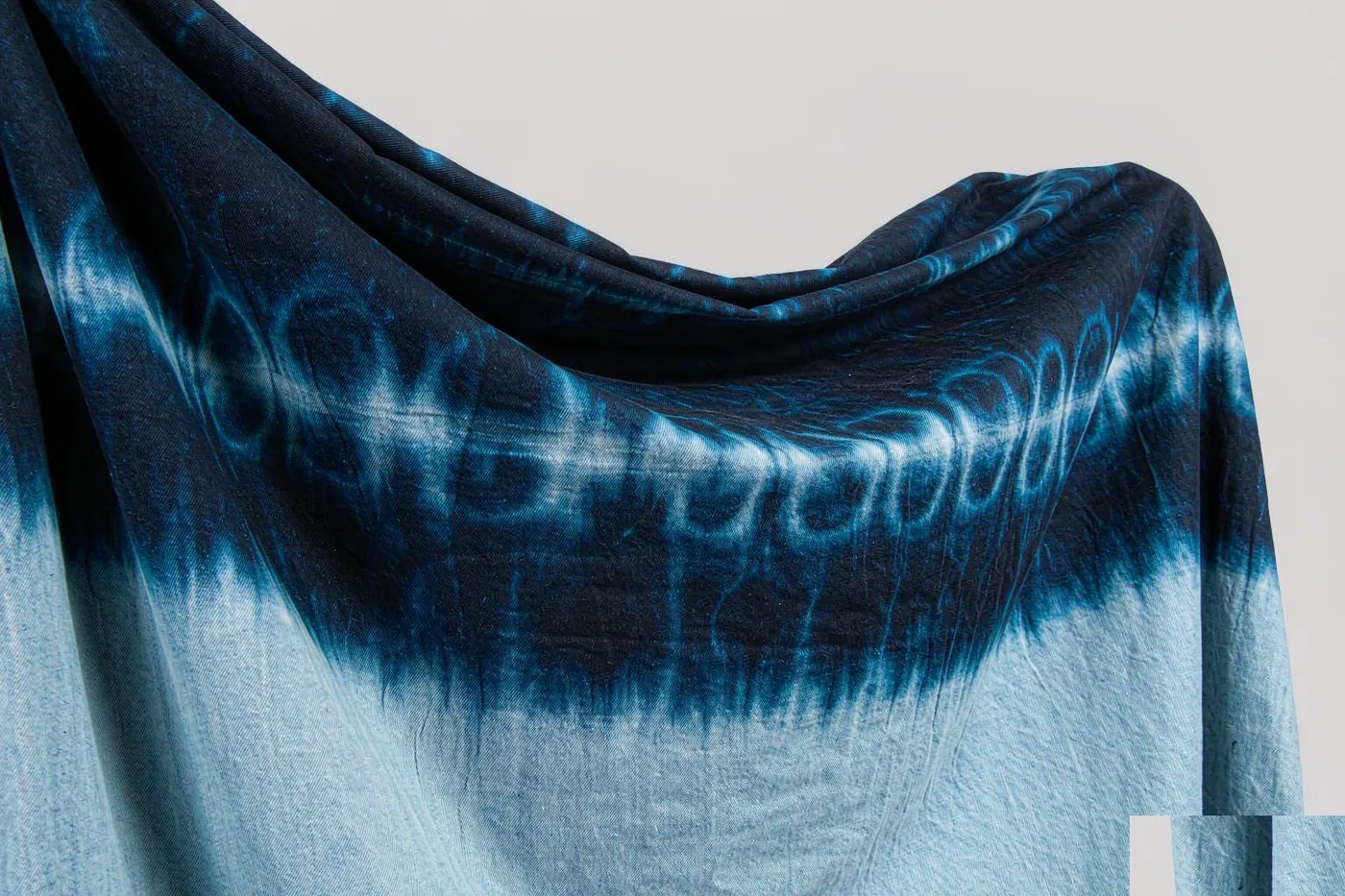
Indigo graduates from deep to pale with a natural bleed at the edge. No two panels are alike — best for small, high-margin runs.
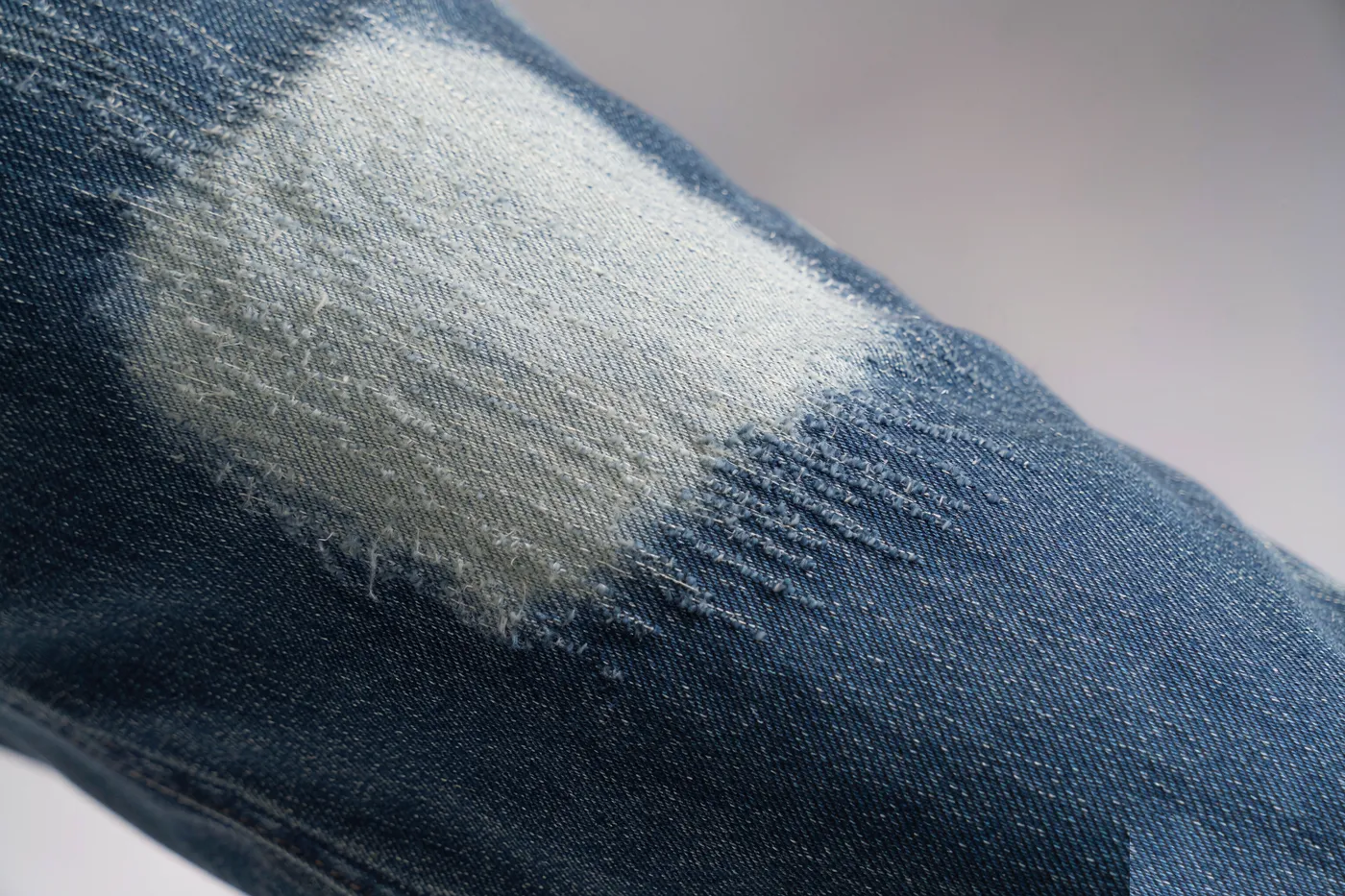
Abraded directionally with sandpaper to cloud or streak the surface, exposing the white weft. Depth is entirely down to hand pressure.
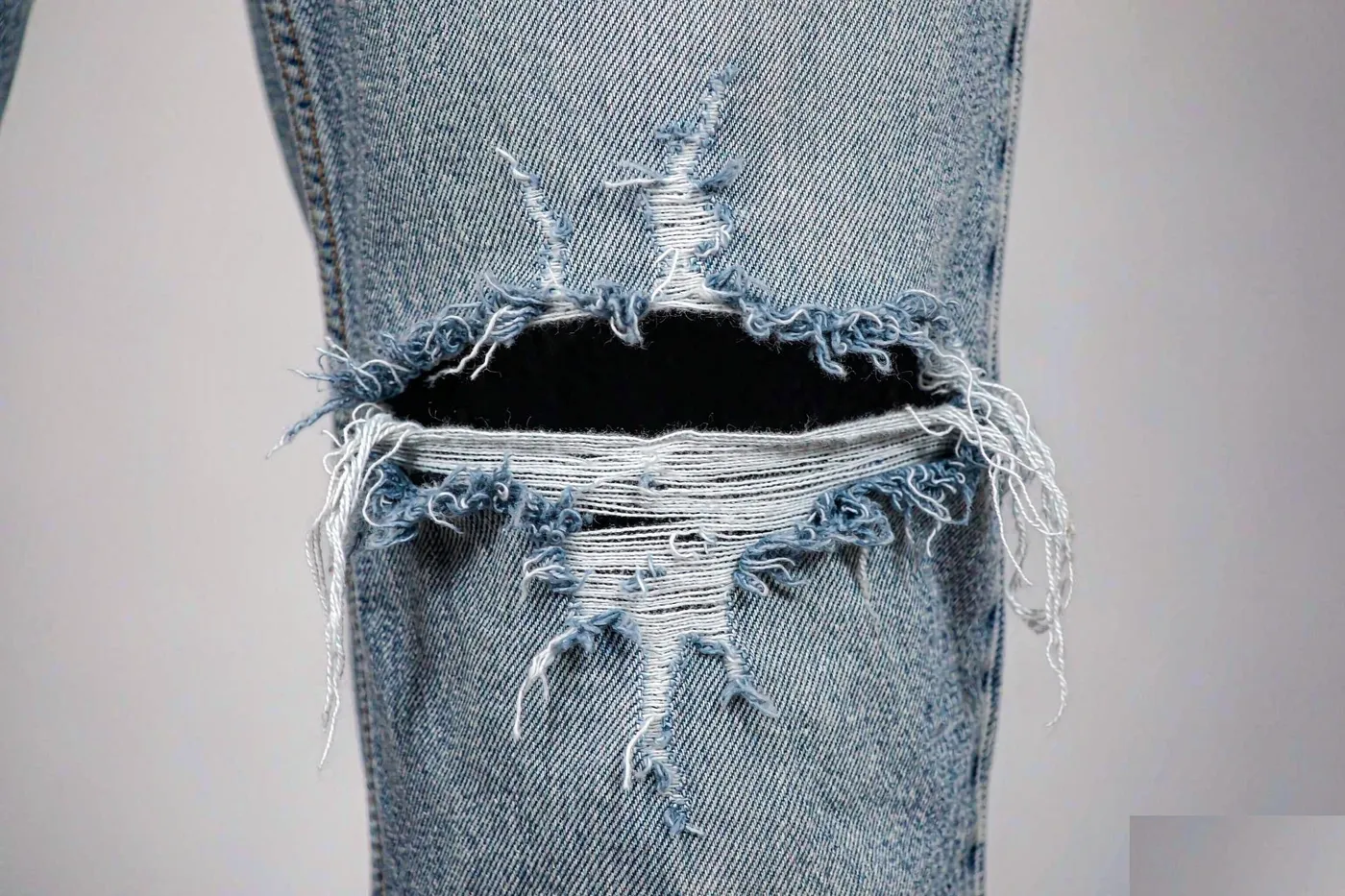
Warp yarns cut, weft left intact to form horizontal threads, finished with abraded edges. Strength drops — care labelling required.
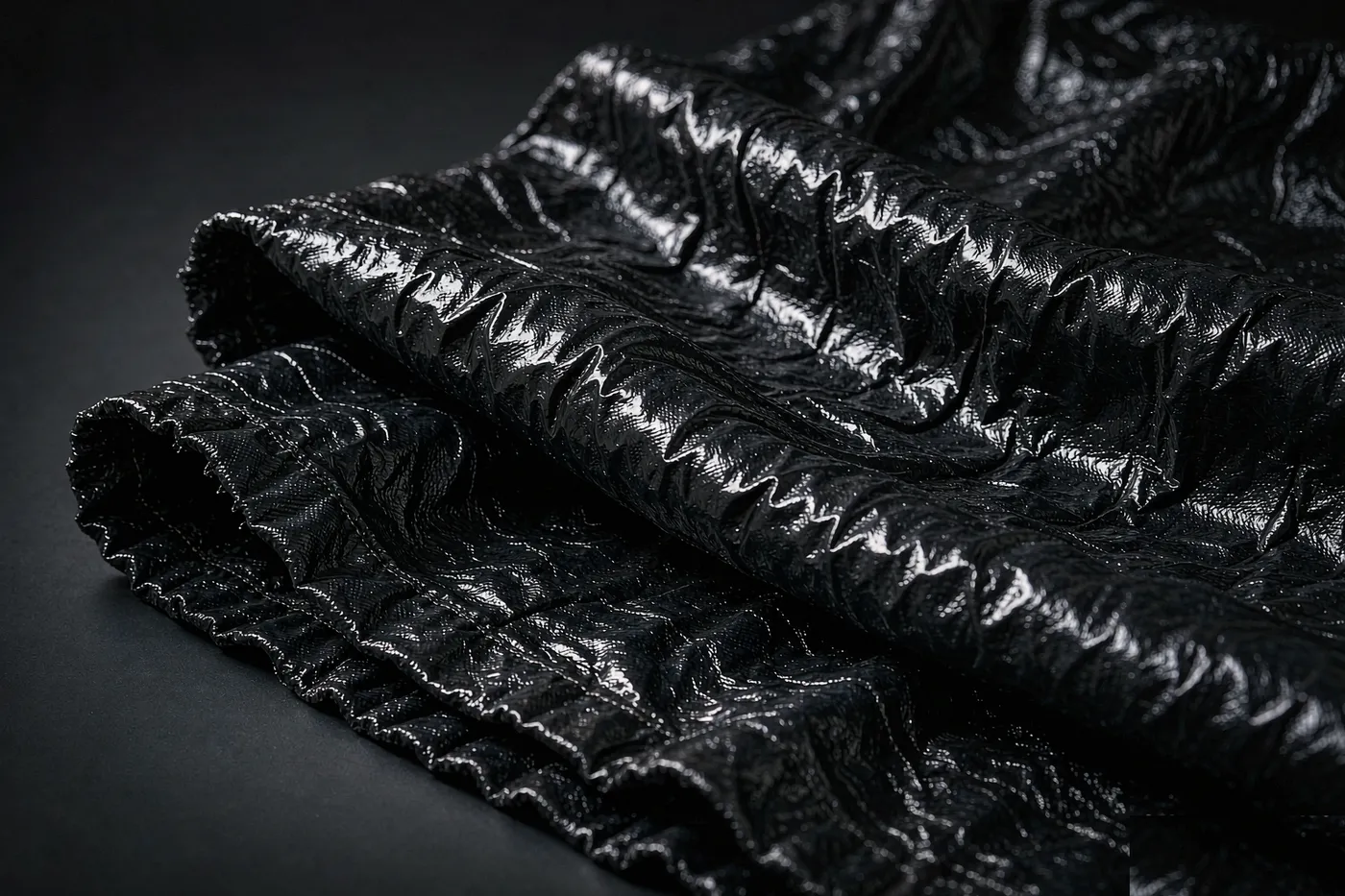
Resin sets permanent three-dimensional creases with a matte coating. Holds its shape — but never press it with heat.
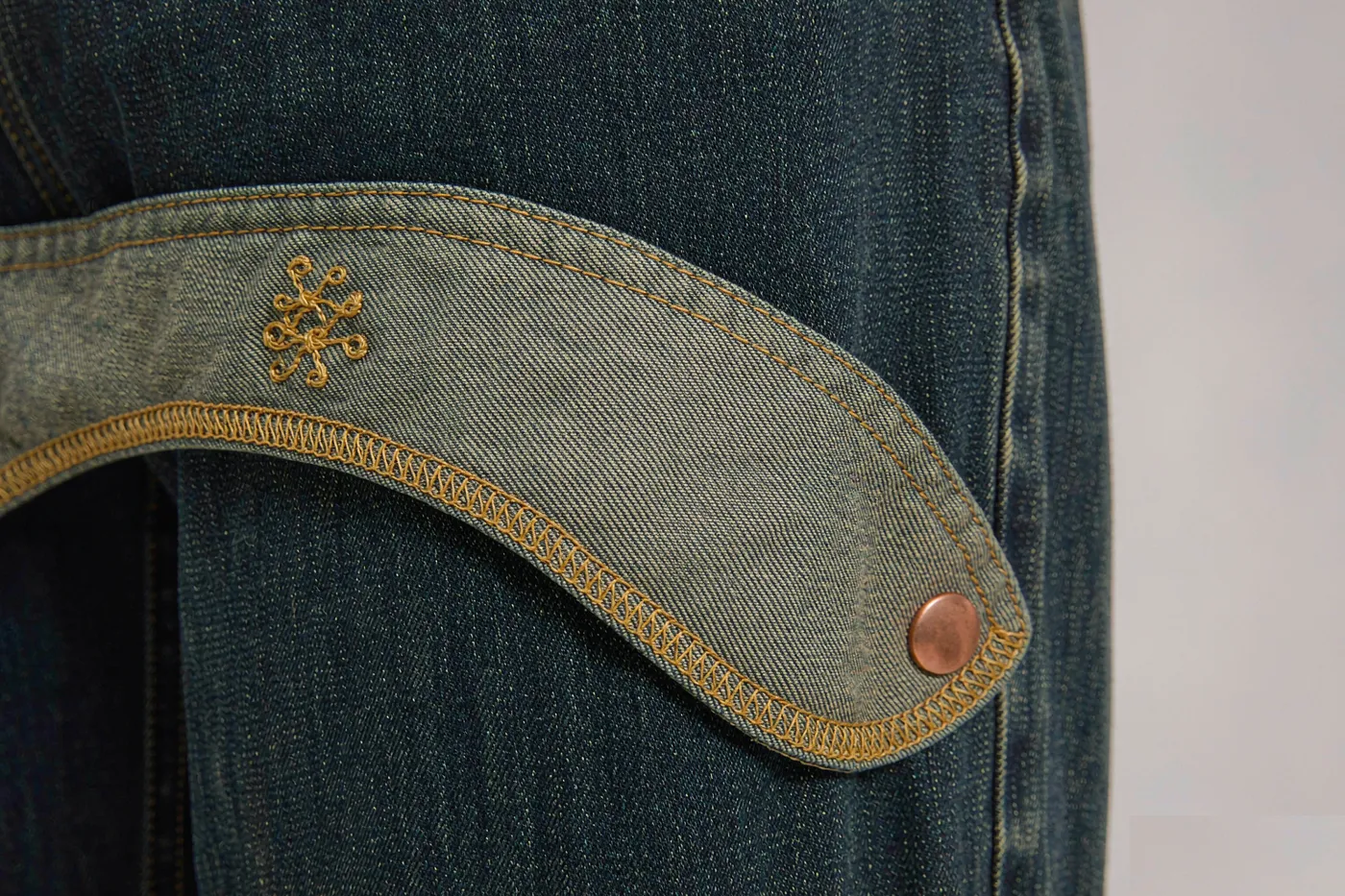
Contrast fabric blocks layered and stitched down with contrast gold thread and embroidery. Standard practice for upcycled and high-end panel work.
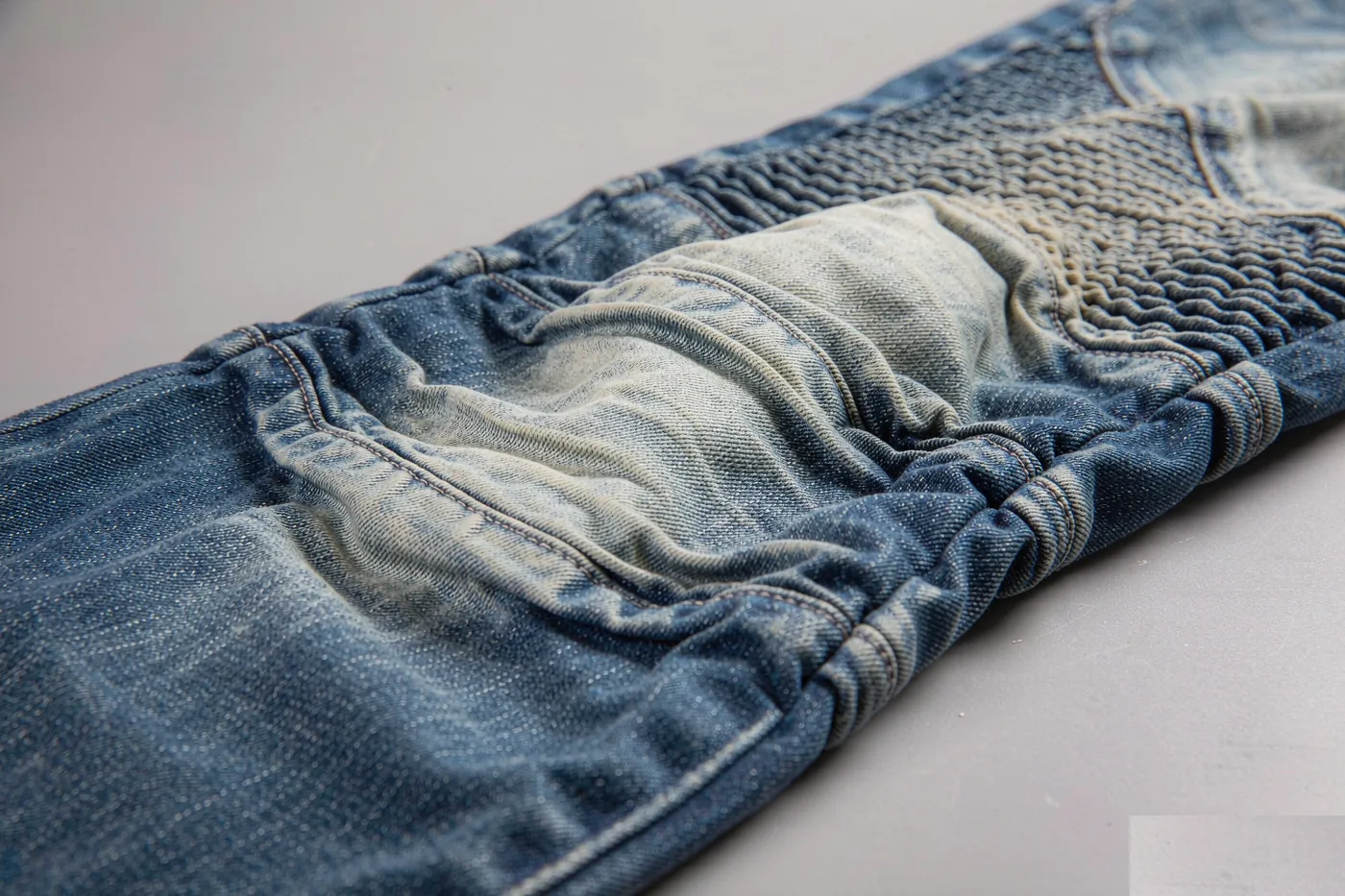
Pressed into 3D creases first, then hand-brushed along the ridge lines. The two positions that sell a jean hardest.
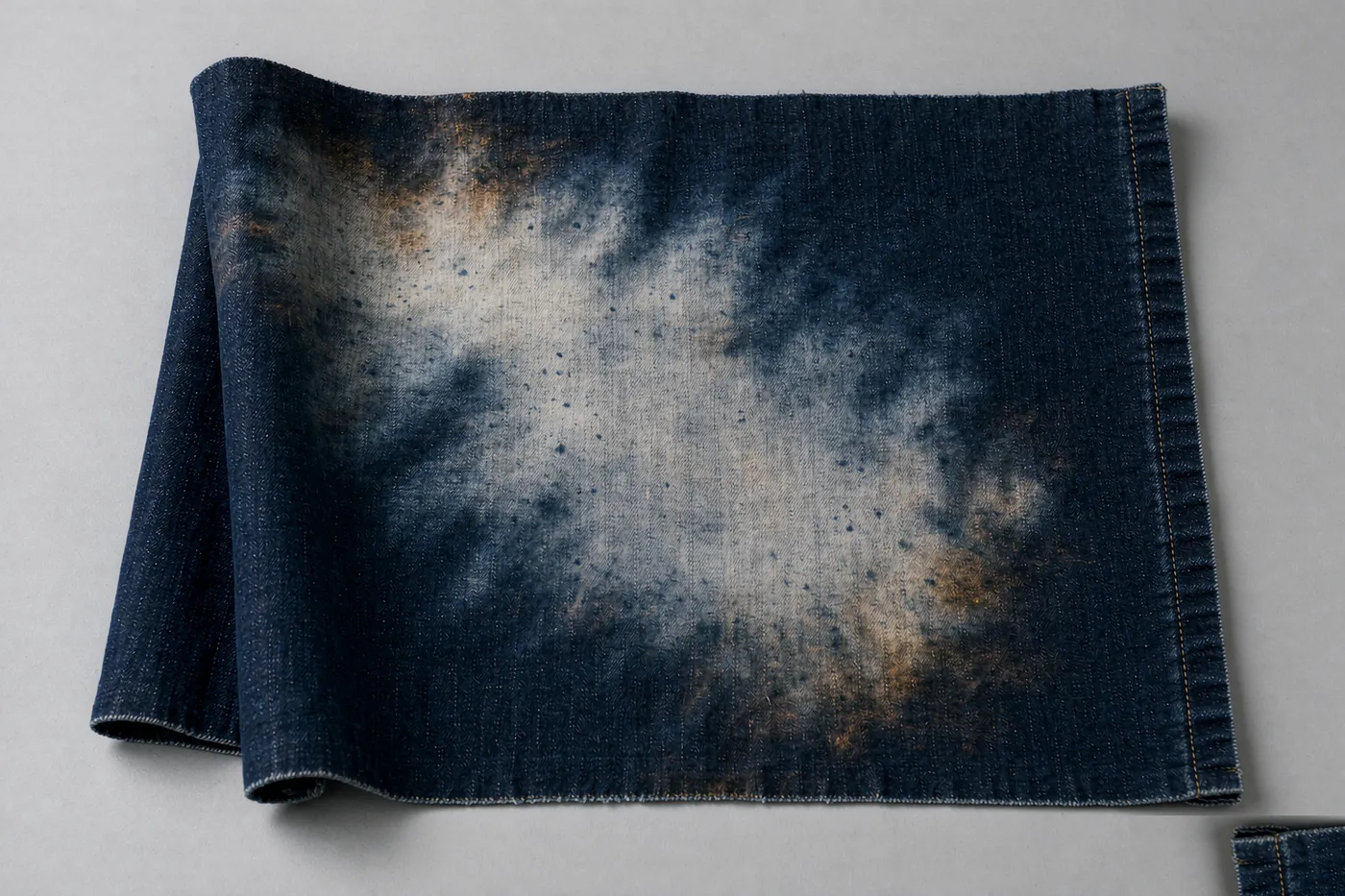
Potassium permanganate sprayed locally to bleach, leaving a warm yellow cast at the edge; must be neutralised after. Depth depends on gun movement and speed.
Red-line selvedge
Woven on narrow shuttle looms so the edge closes itself. The red line is not a print — it is the loom.
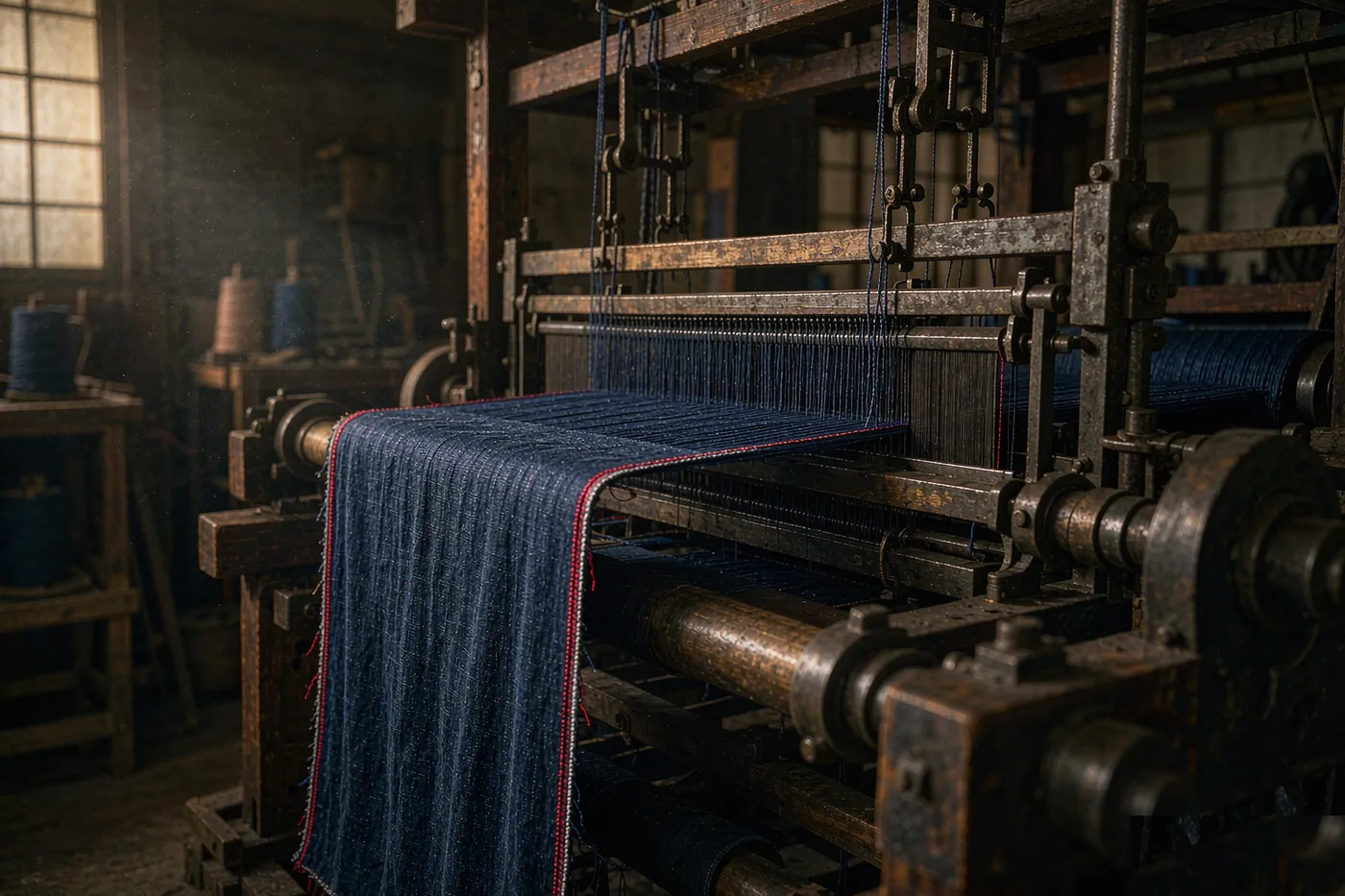
Narrow shuttle looms run slowly and turn the weft back at the edge, so it never frays. That closed edge is where the red line comes from.
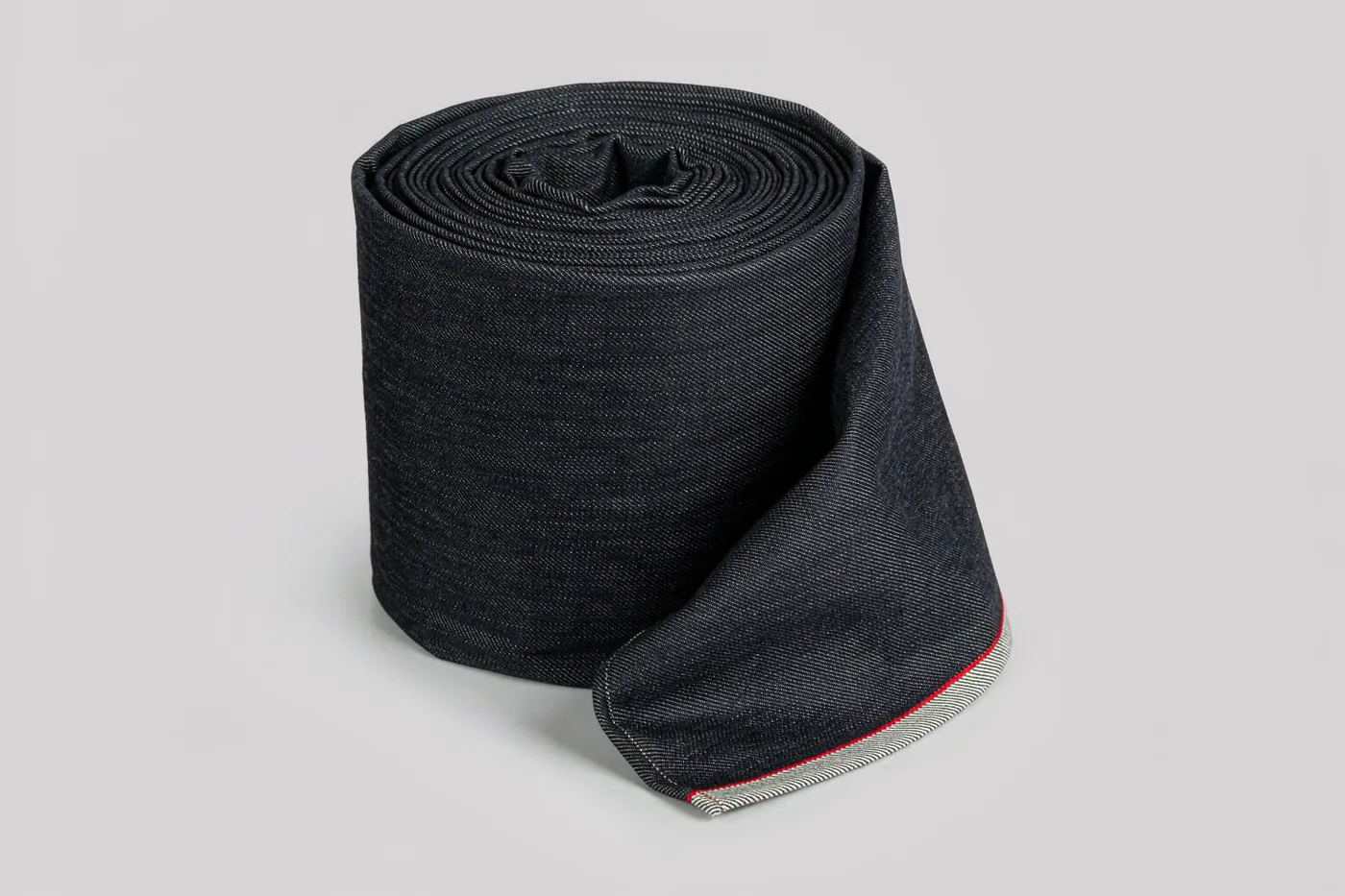
The red line runs continuously down the edge, sometimes over a white or coloured core. The first thing to photograph when proving authenticity.
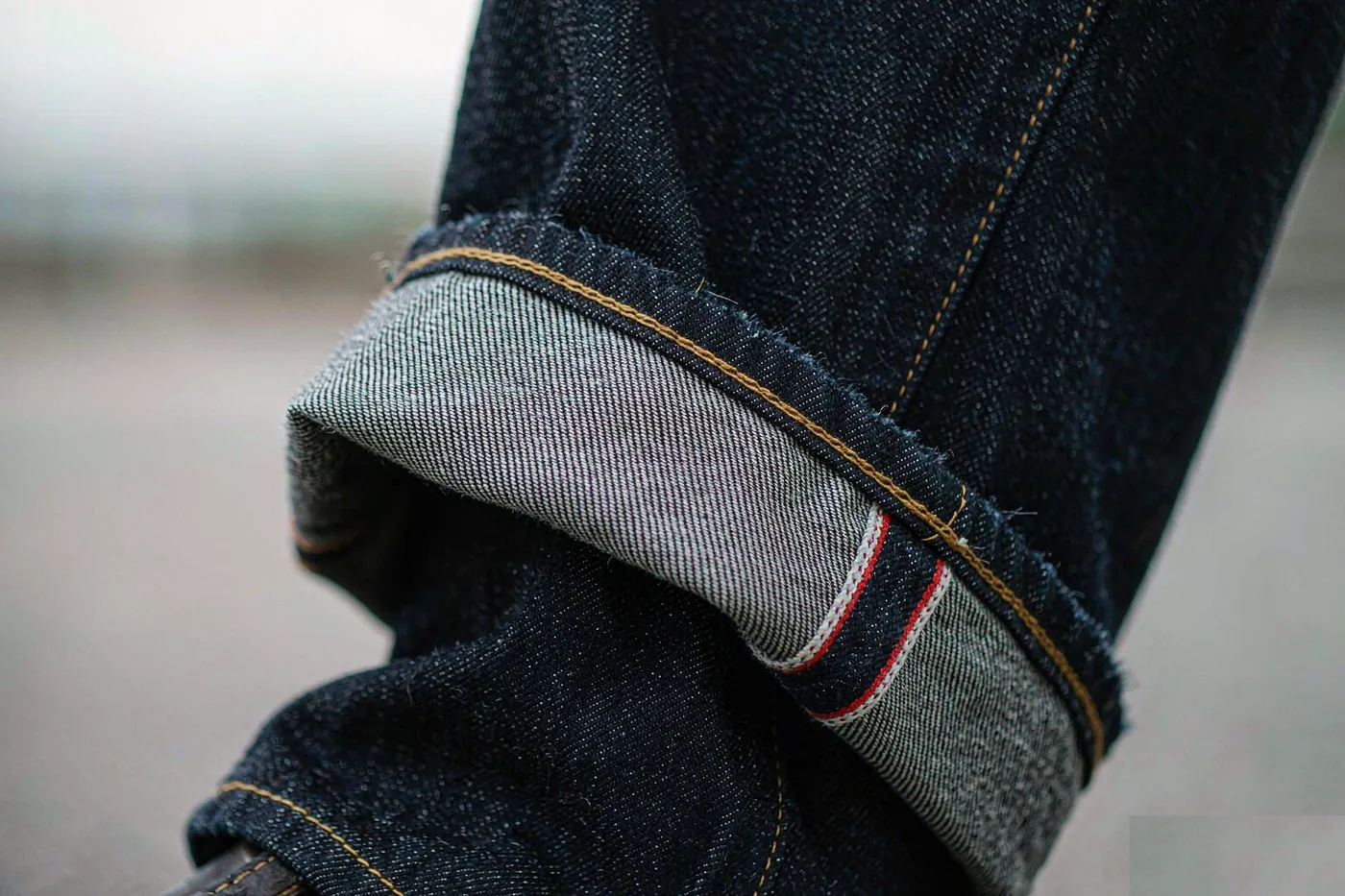
Cuff the hem and the red line shows. The classic way to present a selvedge jean — one shot every product page needs.
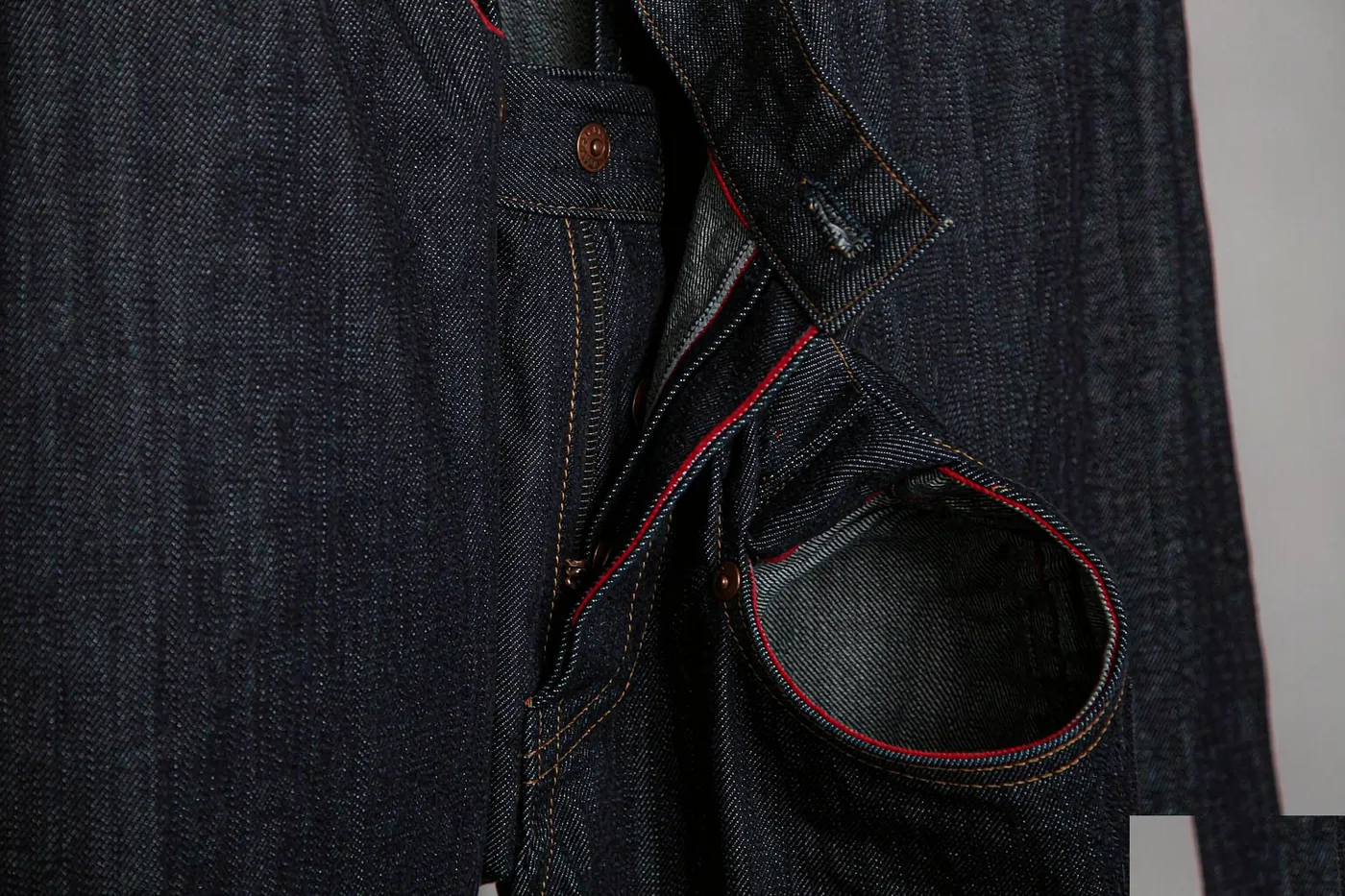
The fly facing and the inside of the coin pocket can keep the selvedge. A detail-collector's selling point, ideal for process explainers.
Hardware & stitch detail
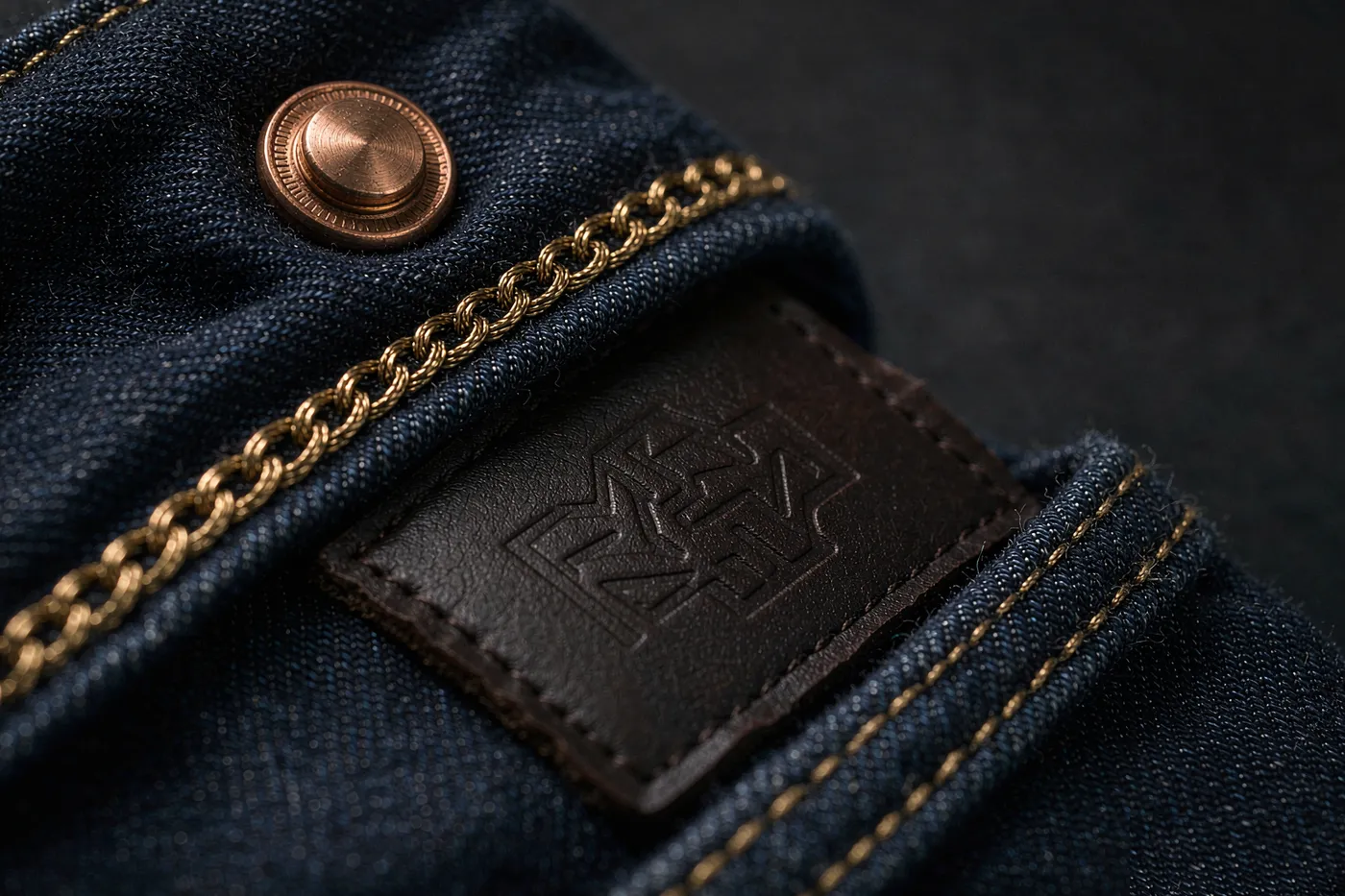
Four close-up positions that convert: rivets and pocket stress points, chain-stitched seams with contrast gold thread, the embossed leather waist patch, and the selvedge-finished edge.
- Rivets at every five-pocket stress point
- Twin-needle chain stitch with contrast gold thread
- Embossed leather waist patch
- Selvedge-finished edge closure
Why we publish this
Most mills treat their standards as a trade secret. We would rather you knew exactly what you are buying before you buy it.
Want your order made to this standard?
Send us your tech pack — or ask us to write one with you. Same standard either way.
Request a quote